

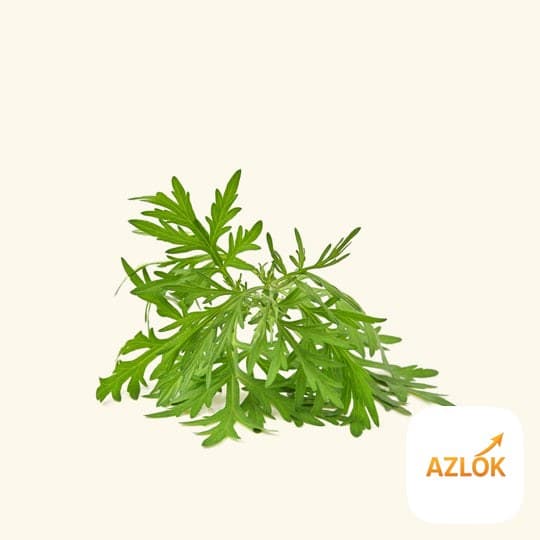

Armoise Essential Oil
Minimum Order: 1 units
Description
Armoise Essential Oil is steam-distilled from the leaves of Artemisia vulgaris (mugwort) and has a fresh, camphoraceous herbal scent. It is used in aromatherapy, perfumery, and soap or candle making. CAS No. 8008-93-3. Available from Azlok in sizes from 50 g to 10 kg. For external use only.
History & Discovery
Armoise oil is derived from Artemisia vulgaris, commonly called mugwort, a plant with a long history of use across Europe, Asia, and the Middle East. The name 'armoise' comes from French, where the Artemisia genus has been used in folk traditions for centuries. Mugwort was historically included in herbal preparations and was valued for its strong aromatic character. Traders along ancient spice and herb routes recognised its distinctive camphoraceous smell, and it was incorporated into incense, fumigants, and rudimentary perfumery well before modern distillation techniques existed.
Scientific & Medicinal Importance
Armoise essential oil is obtained by steam distillation of the dried or fresh leaves of Artemisia vulgaris. The main chemical constituents typically include camphor, 1,8-cineole (eucalyptol), thujone, and various monoterpenes, which together account for its camphoraceous, fresh-herbal odour profile. Its specific gravity is 0.895, relative density 0.886 g/ml, refractive index 1.470, optical rotation -27 to +24°, flash point 100°C, and moisture content 0.01%. It is soluble in alcohols and fixed oils, thin in consistency, and yellow to dark yellow in colour. The CAS number is 8008-93-3 and the FEMA number is 2334. Shelf life is up to two years when stored in a cool, dark place in a tightly sealed container.
Ayurvedic and Traditional Uses
Plants of the Artemisia genus have long been part of traditional practice in India and across Asia. Mugwort grows wild in the Himalayan region, and herbs of this family appear in Ayurvedic and folk traditions. There they were used as dried leaves, smoke or simple preparations rather than as a distilled oil. A close relative, davana (Artemisia pallens), is still grown in Karnataka for its fragrant leaves, which are used in garlands and temple offerings. Steam-distilled armoise oil is a much more recent product, and today it is used for its aroma rather than in traditional practice. The oil contains thujone and camphor, so handle it with care. Always dilute it well, patch test before any skin use and keep it for external use only. Consult a doctor before use if you are pregnant, breastfeeding or on medication.
Modern-Day Applications & Benefits
Today armoise oil is mostly used as a fragrance material. Perfumers value its sharp, green and camphoraceous note in herbal, fougère and chypre-style accords, where a small amount adds a dry, slightly bitter freshness. It blends well with lavender, rosemary, clary sage, cedarwood, patchouli and other woody or mossy notes. Small soap and candle makers use it in cold process and melt-and-pour soaps, soy and paraffin candles, reed diffusers and room sprays. It is usually part of a blend rather than used on its own, because the scent is strong. The oil contains thujone and camphor, so formulators keep usage levels low and check current IFRA guidance for their product type. It is also best left out of products meant for children.
Why Azlok's Version is Trusted Today
Azlok
Frequently asked questions
What is armoise essential oil used for?
Armoise essential oil is used in perfumery, soap making, candle making, incense blending, and aromatherapy diffusers for its fresh, camphoraceous herbal scent. It is for external use only and should not be ingested.
What is the botanical name and CAS number of armoise oil?
The botanical source is Artemisia vulgaris (mugwort). The CAS number is 8008-93-3 and the FEMA number is 2334.
What sizes are available at Azlok and what is the price?
Azlok offers armoise essential oil in 50 g, 100 g, 500 g, 1 kg, 5 kg, and 10 kg packs. The starting price is ₹499. Larger bulk packs are suited for manufacturers and fragrance compounders.
How should armoise essential oil be stored?
Store in a tightly sealed, dark glass bottle away from direct sunlight, heat, and moisture. Keep in a cool, dry place out of reach of children. Properly stored, shelf life is up to two years.
Can I apply armoise essential oil directly on my skin?
No. Armoise oil is concentrated and should never be applied undiluted. Mix a small amount into a carrier oil or finished base, do a patch test first, and use it externally only. Because it contains thujone, avoid it during pregnancy or while breastfeeding, keep it away from children, and consult a doctor if you are on medication.
Specifications
How to use Armoise Essential Oil
Guides covering uses, dilution, safety and storage.