

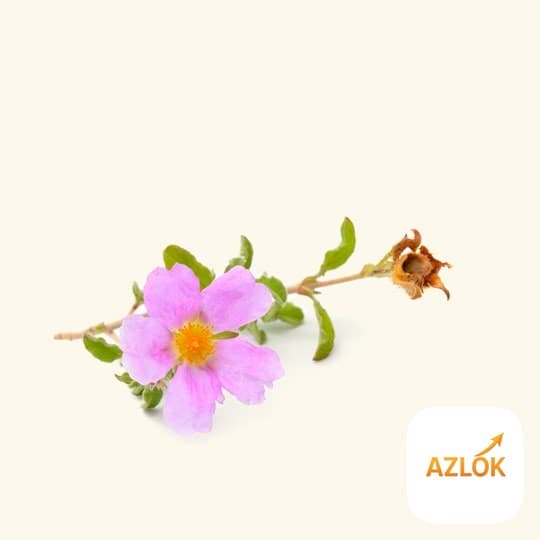

Cistus Essential Oil
Minimum Order: 1 units
Description
Cistus Essential Oil is steam-distilled from the flowers and leaves of Cistus ladanifer (Rock Rose). It has a warm, balsamic, woody, and slightly floral aroma and is used in skin care, aromatherapy, and perfumery. It is valued for its skin-regenerating and anti-aging properties. Available at Azlok in sizes from 10 g to 5 kg.
History & Discovery
Cistus ladanifer, commonly called Rock Rose or Rose of Sharon, is native to the Mediterranean basin, particularly Spain and Portugal. Its sticky resin, known as labdanum, has been harvested for thousands of years. Ancient Egyptians used labdanum in incense, perfumes, and ritual preparations. The plant was also traded along ancient spice routes, making it one of the oldest aromatic materials known to humanity. Cistus resin is referenced in historical texts as one of the ingredients in Kyphi, the Egyptian ceremonial incense blend.
Scientific & Medicinal Importance
Cistus essential oil is a volatile oil obtained by steam distillation of the leafy twigs and flowering tops of Cistus ladanifer. It differs from labdanum absolute or resinoid, which is extracted with solvents from the plant's sticky gum and is darker and thicker. The oil usually contains monoterpenes such as alpha-pinene and camphene, along with bornyl acetate and sesquiterpene alcohols like viridiflorol and ledol. The exact profile varies with growing region, harvest time and distillation method. In appearance it is a pale yellow to golden liquid with a thin to medium consistency. It does not mix with water but dissolves in alcohol and in carrier oils such as jojoba or sweet almond. Its warm, amber-like note is strong and lasting, so perfumers use it in small amounts as a base or middle note.
Modern-Day Applications & Benefits
Today cistus oil is used mainly as a perfumery material. Its warm, balsamic and slightly ambery character helps build amber, chypre and leathery accords, and small amounts add depth to woody, floral and incense-style blends. Natural perfume makers often pair it with frankincense, sandalwood, lavender or citrus oils to round off sharper top notes. DIY formulators and small brands add it to cold-process soaps, candles, reed diffuser blends and roll-on perfume oils for its rich, long-lasting scent. In skincare formulation it appears in face oils, balms and creams mainly for fragrance, always diluted in a carrier oil at a low percentage. As with all essential oils, do a patch test first, use it externally only, and consult a doctor before use if you are pregnant or on medication.
Why Azlok's Version is Trusted Today
Azlok
Frequently asked questions
What is cistus essential oil used for?
Cistus essential oil is primarily used in skin care for scars, wrinkles, and skin tightening, as well as in aromatherapy and perfumery as a warm, balsamic base note.
How do I dilute cistus essential oil for skin use?
Dilute cistus essential oil in a carrier oil such as jojoba or sweet almond oil at 1–2% concentration (about 6–12 drops per 30 ml of carrier oil) before applying to skin. Always do a patch test first.
Which essential oils does cistus blend well with?
Cistus essential oil blends well with ylang ylang, lavender, neroli, clary sage, and cypress essential oils.
Is cistus essential oil safe during pregnancy?
Pregnant women should consult a doctor before using cistus essential oil. It is for external use only.
What is the shelf life and storage recommendation for cistus essential oil?
Cistus essential oil has a shelf life of 2 years. Store it in a cool, dark place away from direct sunlight, heat, and out of reach of children.
Specifications
How to use Cistus Essential Oil
Guides covering uses, dilution, safety and storage.