

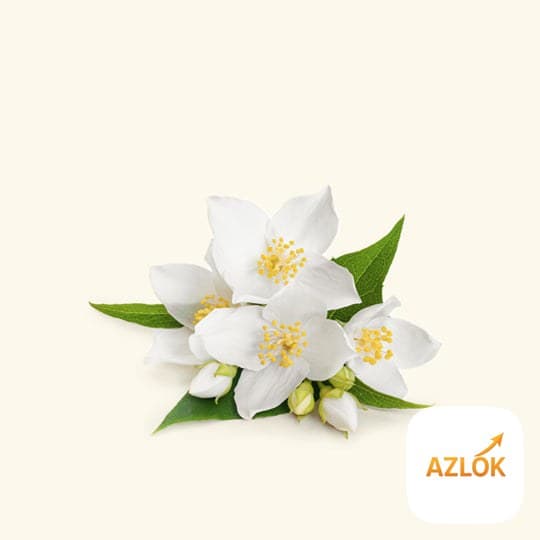

Jasmine Essential Oil
Minimum Order: 1 units
Description
Jasmine Essential Oil (Jasminum sambac) from Azlok is a yellow to dark-yellow transparent liquid extracted from jasmine flowers by steam distillation. Rich in benzyl acetate, linalool, and indole, it is used in perfumery, aromatherapy, skincare, and haircare. For external use only; always dilute before applying to skin.
History & Discovery
Jasmine has been cultivated in India for over two thousand years and holds deep cultural significance in South Asian traditions — used in garlands, religious offerings, and hair adornment. Jasminum sambac, known as mogra or Arabian jasmine, is native to South and Southeast Asia and is the national flower of the Philippines and Indonesia. Its fragrance has been prized in Indian attar-making since the Mughal era, when jasmine-based ittar was a luxury traded across the subcontinent. Today, India — particularly Tamil Nadu, Karnataka, and Andhra Pradesh — remains one of the world's largest producers of jasmine flowers, making Indian jasmine oil highly regarded in global fragrance markets.
Scientific & Medicinal Importance
Azlok's Jasmine Essential Oil is extracted from Jasminum sambac flowers by steam distillation (CAS# 8022-96-6, FEMA 2600). Its key chemical constituents include benzyl acetate, indole, benzyl alcohol, linalool, benzyl benzoate, cineole, β-pinene, borneol, (E)-caryophyllene, and eugenol. Benzyl acetate is largely responsible for the characteristic sweet, floral scent, while linalool contributes calming properties and eugenol adds a mild spicy note. The oil has a specific gravity of 0.899, refractive index of 1.520, optical rotation of -4 to -15° at 20°C, and a flash point of 85°C. It appears as a yellow to dark-yellow transparent liquid, is soluble in alcohols, and has a shelf life of two years when stored in a cool, dark place away from direct sunlight.
Ayurvedic and Traditional Uses
Jasmine has been part of Ayurvedic and wider Indian traditional practice for centuries. Classical Sanskrit texts mention more than one kind: Mallika, generally identified with Jasminum sambac (mogra), and Jati, usually linked with Jasminum grandiflorum (chameli). The flowers appear in descriptions of fragrant materials used in daily grooming, garlands and temple offerings. Many households also steeped fresh blossoms in sesame or coconut oil to make scented hair oils. Distilled essential oil is a more recent form. Earlier, jasmine fragrance was mostly captured through oil infusions and traditional attars, such as the motia and chameli attars of Kannauj. If you use jasmine essential oil in traditional-style preparations, dilute it well in a carrier oil and use it externally only. Do a patch test first, and consult a doctor if you are pregnant or on medication.
Modern-Day Applications & Benefits
In modern cosmetic and personal care formulations, jasmine essential oil is widely used in perfumes, eau de toilettes, body lotions, face serums, hair oils, and candles. Its long-lasting floral fragrance makes it one of the most sought-after ingredients in fine fragrance blending. It blends well with rose, geranium, sandalwood, lavender, and frankincense essential oils, and with all types of carrier oils. Aromatherapists use jasmine oil in diffusers for mood support and stress relief. For DIY soap and candle makers, it provides a rich, warm floral note; usage rates typically follow supplier or industry guidelines for leave-on versus rinse-off products. Azlok offers this oil in sizes from 100g up to 20kg, making it suitable for individual crafters, small businesses, and commercial manufacturers alike.
Why Azlok's Version is Trusted Today
Azlok
Frequently asked questions
Is Azlok Jasmine Essential Oil pure or blended?
Azlok's Jasmine Essential Oil is a steam-distilled oil from Jasminum sambac flowers. Check the product label and COA for purity details. It is not listed as a blend; its constituents include benzyl acetate, linalool, indole, and others as noted in the specifications.
How should I dilute jasmine essential oil before applying to skin?
Always dilute jasmine essential oil in a carrier oil (such as jojoba, sweet almond, or coconut oil) before applying to skin. A common dilution rate is 1–2% for face applications (1–2 drops per teaspoon of carrier oil) and up to 3% for body use. Do a patch test first and wait 24 hours to check for any reaction.
Can pregnant women use jasmine essential oil?
Pregnant women should consult a qualified doctor or healthcare provider before using jasmine essential oil, as some essential oils are not recommended during pregnancy. This is a standard caution listed on the product.
What does jasmine essential oil blend well with?
Jasmine essential oil blends well with rose, geranium, sandalwood, lavender, and frankincense essential oils. It is also compatible with all types of carrier oils. These combinations are popular in perfumery, aromatherapy, and DIY cosmetic formulations.
What pack sizes are available and is bulk supply possible?
Azlok offers Jasmine Essential Oil in 100g, 500g, 1kg, 5kg, 10kg, and 20kg packs, making it suitable for individual buyers, small DIY businesses, and commercial manufacturers who need bulk quantities.
Specifications
How to use Jasmine Essential Oil
Guides covering uses, dilution, safety and storage.