

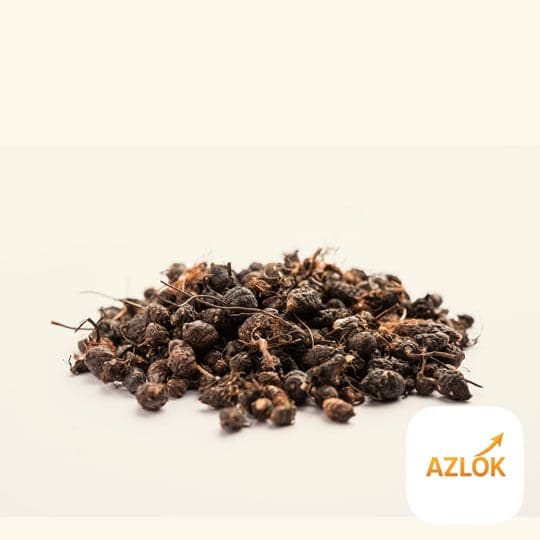

Nagarmotha Essential Oil
Minimum Order: 1 units
Description
Nagarmotha Essential Oil is steam-distilled from the roots of Cyperus scariosus, yielding a pale yellow to brown liquid with a rich, earthy, woody aroma. Available at Azlok in sizes from 50 g to 10 kg. For external use only; dilute before application.
History & Discovery
Nagarmotha, known botanically as Cyperus scariosus, is a sedge grass native to the Indian subcontinent. Its aromatic roots have been used for centuries in Indian traditional medicine, perfumery, and fumigation. Sanskrit texts reference this plant as 'Mustaka', and it has long been traded across South Asia and the Middle East as a valued aromatic root. Historically, the dried roots were burned as incense, incorporated into hair oils, and used in Unani formulations for their cooling and fragrant properties.
Scientific & Medicinal Importance
Nagarmotha essential oil is obtained by steam distillation of the dried roots (rhizomes and tubers) of Cyperus scariosus, a sedge that grows in moist ground across India. The oil is mainly made up of sesquiterpenes and sesquiterpene ketones. Compounds such as cyperene and cyperone are commonly reported, though the exact profile varies with the region, season and age of the roots used. In practical terms, it is a fairly thick oil ranging from pale yellow to brown, with a deep, earthy, woody and slightly smoky smell. Because its components evaporate slowly, it behaves as a base note and lingers well after lighter notes fade. It mixes with alcohol and most carrier oils but not with water, so it needs a solubiliser for water-based products.
Ayurvedic and Traditional Uses
In Ayurveda, nagarmotha is usually identified with Mustaka, also called Musta or Bhadramusta, a name found in classical Sanskrit texts. Closely related Cyperus species are sometimes known by the same name, so regional usage can vary. Traditionally it was the dried tubers, not a distilled oil, that were used. They have been part of Ayurvedic and folk practice for centuries, appearing in powders, decoctions and herbal preparations. In everyday life, the fragrant roots also went into ubtan-style bathing powders, hair-washing mixtures and dhoop. Today's essential oil is far more concentrated than these traditional preparations and should not be treated as a substitute for them. Use it externally only and well diluted, and do a patch test first. Consult a doctor before use if you are pregnant or on medication.
Modern-Day Applications & Benefits
Today nagarmotha oil is used mostly in fragrance work. Attar makers and perfumers use it as a base note and fixative, often alongside vetiver, sandalwood, patchouli, rose and oud-style accords, to give a blend depth and staying power. It is also a familiar note in agarbatti, dhoop and incense masalas, and in room and linen fragrance blends. Small brands and DIY makers add it in low amounts to cold process soaps, melt-and-pour bars and candles for an earthy, woody character. Some formulators include it, well diluted in a carrier oil, in hair oils, body oils and skincare blends for its aroma. For any product applied to skin, dilute properly, do a patch test first, keep it for external use only and consult a doctor if pregnant or on medication.
Why Azlok's Version is Trusted Today
Azlok
Frequently asked questions
Can nagarmotha essential oil be applied directly to the scalp?
No, you should always dilute it in a carrier oil such as coconut or jojoba oil at a concentration of 1–3% before applying to the scalp. Direct application of undiluted essential oils can cause irritation. Do a patch test first.
Is nagarmotha essential oil safe during pregnancy?
Pregnant women should consult a doctor before using any essential oil, including nagarmotha oil. It is not recommended for use during pregnancy without medical guidance.
What does nagarmotha essential oil smell like?
It has a rich, earthy, woody, and slightly musky aroma — similar in character to vetiver and patchouli. It is commonly used as a base note in perfumes and blends well with clary sage, vetiver, patchouli, and cassia oils.
What is the shelf life and how should I store it?
The shelf life is 2 years from the date of manufacture. Store in a cool, dry place away from direct sunlight and heat sources. Because the flash point is 35°C, keep it away from open flames. Keep the bottle tightly closed and out of reach of children.
In what sizes is Azlok's nagarmotha essential oil available?
Azlok offers nagarmotha essential oil in 50 g, 100 g, 500 g, 1 kg, 5 kg, and 10 kg packs, making it suitable for both home users and commercial formulators or businesses.
Specifications
How to use Nagarmotha Essential Oil
Guides covering uses, dilution, safety and storage.