

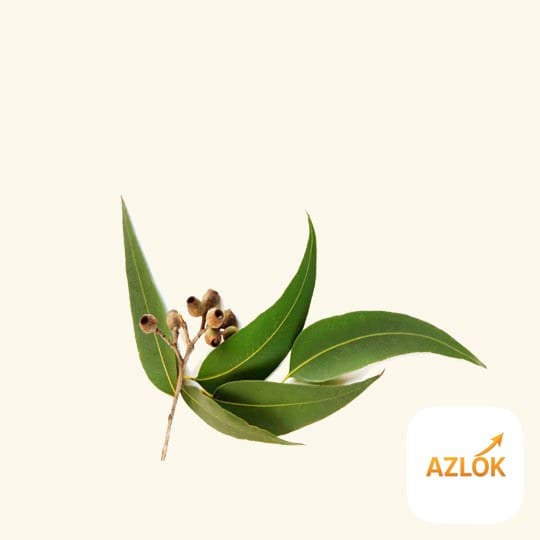

Nilgiri Oil
Minimum Order: 1 units
Description
Nilgiri Oil (CAS 8000-48-4) is a steam-distilled essential oil extracted from the leaves and flowers of Nilgiri (Eucalyptus) trees grown in India. It has a characteristic herbaceous, camphor-like aroma and is widely used in aromatherapy, diffuser blends, candle and soap making, and as a natural decongestant. Always dilute before skin application. Available from Azlok in sizes from 100 g to 25 kg.
History & Discovery
Nilgiri oil is derived from Eucalyptus trees, a genus native to Australia but extensively cultivated in India's Nilgiri Hills (Blue Mountains) of Tamil Nadu and in parts of Karnataka and Andhra Pradesh since the 19th century. The British colonial administration introduced large-scale Eucalyptus plantations in the Nilgiris primarily for timber and fuel, but local communities quickly recognised the medicinal value of the strongly aromatic leaves. Traditional healers in South India used the crushed leaves and leaf steam to relieve respiratory congestion, headaches, and muscle aches long before commercial oil extraction began. The name 'Nilgiri' literally means 'Blue Mountains' in Tamil and Telugu, referencing the bluish haze created by volatile oils released by Eucalyptus trees covering those hills.
Scientific & Medicinal Importance
Nilgiri oil is produced by steam distillation of freshly crushed or dried leaves and flowers of Eucalyptus species, primarily Eucalyptus globulus. The CAS number 8000-48-4 identifies this as a complex natural mixture. Its major active constituent is 1,8-cineole (eucalyptol), which can comprise 60–80% of the oil and is responsible for its characteristic camphor-like odour and most of its functional properties. The oil's specific gravity (0.855–0.870 at 20°C) and refractive index (1.450–1.464 at 20°C) are standard quality parameters used to verify purity. With a flash point of 180°C, the oil is relatively safe to handle at room temperature but should still be kept away from open flames. The oil is soluble in alcohol and fixed oils but poorly soluble in water, which is why a carrier oil must be used for skin applications.
Ayurvedic and Traditional Uses
In Ayurvedic practice, Eucalyptus (known as Tailaparna or Nilgiri) is classified as having heating (ushna) and penetrating (tikshna) qualities. It is considered beneficial for balancing Kapha dosha and is traditionally used to support respiratory health — for example, adding a few drops to hot water for steam inhalation during cough and cold. Ayurvedic practitioners also use diluted Nilgiri oil in massage formulations to ease joint stiffness and muscle pain. However, Ayurveda recommends caution: the oil should never be used internally without expert guidance, and it should not be applied undiluted on skin.
Modern-Day Applications & Benefits
Today Nilgiri oil is valued mainly for its fresh, sharp, camphor-like aroma. Home users add a few drops to diffusers, room sprays and linen sprays. Fragrance blenders pair it with peppermint, lemongrass, lavender, rosemary or tea tree for clean, cooling notes. Soap and candle makers use it in cold-process and melt-and-pour soaps, wax melts and candles. Keep usage rates within the limits given in your formulation guide, because a little goes a long way. Small brands also use it as a fragrance component in balms, massage oil blends, foot creams and hair oils. In these products it is always diluted in a carrier such as coconut, sesame or sweet almond oil. Nilgiri oil is an essential oil, not a carrier oil, so never apply it neat. Patch test first and use it externally only. Keep it away from eyes and children, and consult a doctor if you are pregnant or on medication.
Why Azlok's Version is Trusted Today
Azlok
Frequently asked questions
What is Nilgiri Oil and how is it different from regular Eucalyptus oil?
Nilgiri Oil and Eucalyptus oil refer to the same product in Indian markets. 'Nilgiri' is the Indian trade name for oil extracted from Eucalyptus trees cultivated in the Nilgiri Hills and surrounding regions of South India. It is steam-distilled from leaves and flowers and shares the same CAS number (8000-48-4).
Can Nilgiri Oil be applied directly to the skin?
No. Nilgiri Oil is a concentrated essential oil and must be diluted with a carrier oil (such as coconut or almond oil) before skin application — typically 2–3 drops of Nilgiri Oil per teaspoon of carrier oil. Applying it undiluted can cause skin irritation or sensitisation. Always do a patch test first.
Is Nilgiri Oil edible or food-grade?
No, Nilgiri Oil as sold by Azlok is an essential oil for aromatherapy, topical (diluted), and craft use only. It is not intended for internal consumption. Do not ingest it. Keep out of reach of children.
How do I use Nilgiri Oil in a diffuser?
Add 5–8 drops of Nilgiri Oil to your diffuser's water tank as per the diffuser's instructions. It blends well with Lavender, Cedarwood, or Thyme oils. Run the diffuser in a well-ventilated room and avoid prolonged exposure for infants, elderly persons, or pets.
What bulk sizes does Azlok offer and is the price different?
Azlok offers Nilgiri Oil in 100 g, 500 g, 1 kg, 5 kg, 10 kg, 20 kg, and 25 kg packs. Bulk pricing is available for larger quantities, making it suitable for soap and candle manufacturers, aromatherapy businesses, and industrial buyers. Contact Azlok directly for bulk quotes.
Specifications
How to use Nilgiri Oil
Guides covering uses, dilution, safety and storage.