

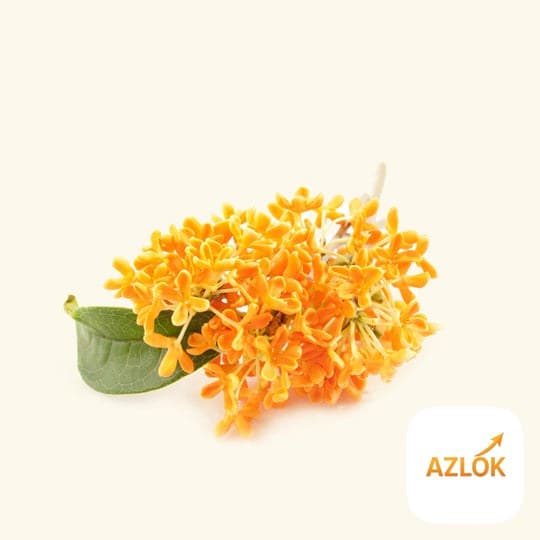
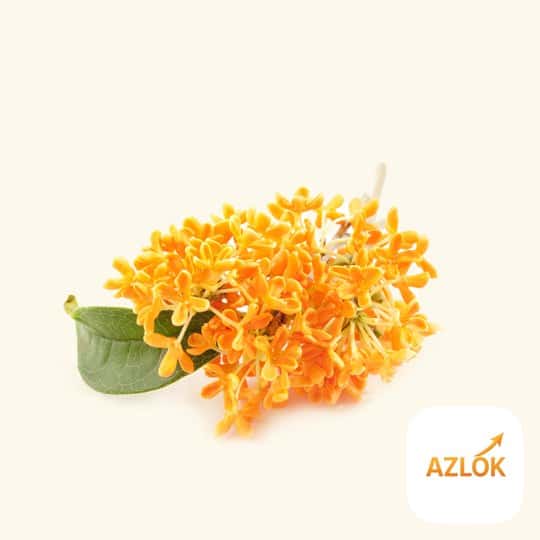
Osmanthus Essential Oil
Minimum Order: 1 units
Description
Osmanthus Essential Oil is steam-distilled from the flowers and leaves of Osmanthus fragrans, yielding a golden-yellow liquid with a rich fruity-floral scent of apricot and honey. Used in perfumery, skincare, and DIY cosmetics, it blends well with ginger, lemon, lime, and linden absolute. Available from Azlok in sizes from 50 g to 10 kg.
History & Discovery
Osmanthus fragrans, commonly called sweet osmanthus or fragrant olive, is native to Asia and has been cultivated in China for over 2,500 years. Its flowers are prized in Chinese culture for flavouring tea, wine, and desserts, and the plant holds deep symbolic meaning associated with love and good luck. In Japan and across East Asia, osmanthus gardens remain central to cultural celebrations during the autumn bloom season. The essential oil became a fixture in high-end Western perfumery during the 20th century, valued for its rare apricot-honey character that is difficult to replicate synthetically.
Scientific & Medicinal Importance
Osmanthus essential oil is extracted by steam distillation of the flowers and leaves of Osmanthus fragrans. Its major chemical constituents include ketones, alcohols, esters, aldehydes, and acids. Key aroma compounds such as beta-ionone and gamma-decalactone are responsible for its characteristic apricot and violet-like notes. The oil has a specific gravity of 0.948–0.965, a refractive index of 1.470–1.500, and a flash point of 100°C, making it relatively stable compared to many other floral oils. It is soluble in alcohol and presents as a transparent golden-yellow liquid. CAS number 68917-05-5 and FEMA number 3750 identify it in regulatory and fragrance industry databases.
Modern-Day Applications & Benefits
In modern aromatherapy and cosmetic formulation, osmanthus essential oil is used primarily for its skin-soothing and mild antioxidant properties. It is incorporated into serums, facial oils, and anti-aging creams. In perfumery, it serves as a middle-to-base note that adds a luxurious fruity-floral depth and blends effectively with ginger, lemon, lime, and linden absolute. DIY soap and candle makers use it for its long-lasting floral scent. It is strictly for external use; always dilute to 1–2% in a carrier oil before skin application and perform a patch test. Avoid use during pregnancy without medical advice, and keep away from direct sunlight after application.
Why Azlok's Version is Trusted Today
Azlok
Frequently asked questions
Is osmanthus essential oil safe to apply directly on skin?
No. Osmanthus essential oil must be diluted in a carrier oil (such as jojoba or sweet almond oil) at 1–2% before skin application. Always do a patch test first. Undiluted application can cause irritation.
What does osmanthus essential oil smell like?
It has a rich, fruity-floral scent with prominent notes of apricot and honey, along with a fresh, herbaceous undertone. It is often described as luxurious and warm.
Can pregnant women use osmanthus essential oil?
Pregnant women should consult a qualified doctor before using any essential oil, including osmanthus. As a precaution, avoid use during pregnancy unless medically advised.
Which oils blend well with osmanthus essential oil?
Osmanthus essential oil blends well with ginger, lemon, lime, and linden absolute. It pairs nicely in perfumery and DIY diffuser blends where a fruity-floral base note is desired.
What is the shelf life and storage recommendation for osmanthus essential oil?
The shelf life is 2 years from the date of manufacture. Store in a cool, dark place, tightly sealed, away from direct sunlight, heat, and children's reach to preserve its aroma and quality.
Specifications
How to use Osmanthus Essential Oil
Guides covering uses, dilution, safety and storage.