

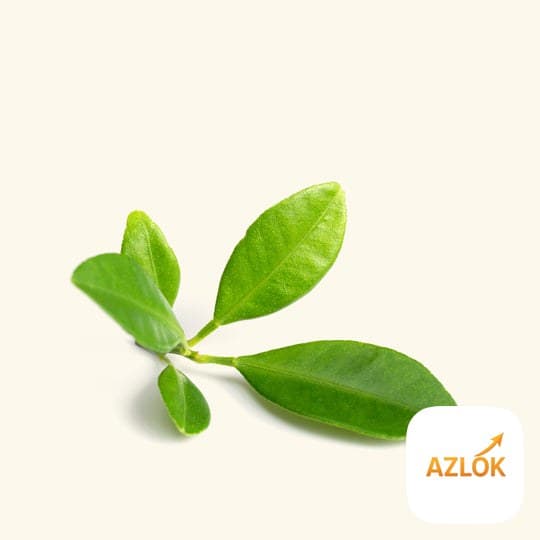

Petitgrain Essential Oil
Minimum Order: 1 units
Description
Petitgrain Essential Oil is steam-distilled from the leaves and green twigs of Citrus aurantium (bitter orange). It has a fresh, citrusy, and slightly woody aroma and is widely used in aromatherapy, skincare formulations, perfumery, and soap and candle making. Available at Azlok in sizes from 50 g to 25 kg.
History & Discovery
Petitgrain oil takes its name from the French phrase meaning 'little grains,' referring to the small unripe fruits originally used for distillation. Over time, the industry shifted to using leaves and green twigs of Citrus aurantium (bitter orange), which yield a higher volume of oil with a consistent aroma profile. The bitter orange tree is native to Southeast Asia but has been cultivated extensively across the Mediterranean, Paraguay, and parts of India for centuries. Petitgrain became a staple ingredient in classic European eau de cologne formulations, particularly in the 18th and 19th centuries, and remains a valued base and middle note in fine perfumery today.
Scientific & Medicinal Importance
Petitgrain Essential Oil is obtained by steam distillation of the fresh leaves and young twigs of Citrus aurantium var. amara. Its main chemical constituents include linalyl acetate (40–55%), linalool (15–25%), alpha-terpineol, geranyl acetate, and myrcene. Linalyl acetate and linalool together contribute to the oil's documented calming and muscle-relaxant properties. The oil has a specific gravity of 0.878–0.889 at 25°C, a refractive index of 1.450–1.460 at 20°C, and a flash point of 66°C. It is soluble in alcohols and fixed oils but not in water. These physicochemical properties make it suitable for use in alcohol-based perfumes, water-in-oil emulsions, and soap and candle formulations.
Modern-Day Applications & Benefits
Today, petitgrain essential oil is a regular ingredient in perfumery and personal care. Perfumers use it as a fresh, green-citrus top and middle note, especially in eau de cologne-style blends, where it pairs well with neroli, bergamot, lavender and woody notes. Small brands add it to diluted body oils, lotions, creams and hair oils for its clean, slightly floral scent, keeping the oil well diluted in a carrier and advising a patch test before use. It is for external use only. In home crafting, petitgrain is used to scent cold process and melt-and-pour soaps, soy and paraffin candles, reed diffusers and room sprays. Its aroma blends easily, so many formulators use it to round off sharper citrus oils or to give herbal blends a lighter finish. It is also a popular choice for diffuser blends at home and in small studios.
Why Azlok's Version is Trusted Today
Azlok
Frequently asked questions
What does petitgrain essential oil smell like?
Petitgrain essential oil has a fresh, citrusy, and slightly woody aroma with a subtle floral undertone. It is often described as clean and green, similar to neroli but with a more earthy quality.
How should I dilute petitgrain essential oil for skin use?
Dilute petitgrain essential oil to 1–2% in a carrier oil (about 6–12 drops per 30 ml of carrier oil) before applying to skin. Always do a patch test first. Avoid applying to broken or sensitive skin without guidance from a dermatologist.
Can petitgrain essential oil be used in candle and soap making?
Yes, petitgrain essential oil is suitable for both cold-process soap and candle making. Its flash point of 66°C means it should be added to wax or soap base at temperatures below that point to preserve the scent.
Is petitgrain essential oil safe during pregnancy?
Pregnant women should consult a qualified doctor or healthcare provider before using petitgrain or any essential oil, as safety data specific to pregnancy is limited.
Which essential oils blend well with petitgrain?
Petitgrain blends well with lavender, rosemary, sandalwood, clove bud, and orange essential oils. It also mixes well with all carrier oils, making it versatile for massage blends, diffuser recipes, and skincare formulations.
Specifications
How to use Petitgrain Essential Oil
Guides covering uses, dilution, safety and storage.