

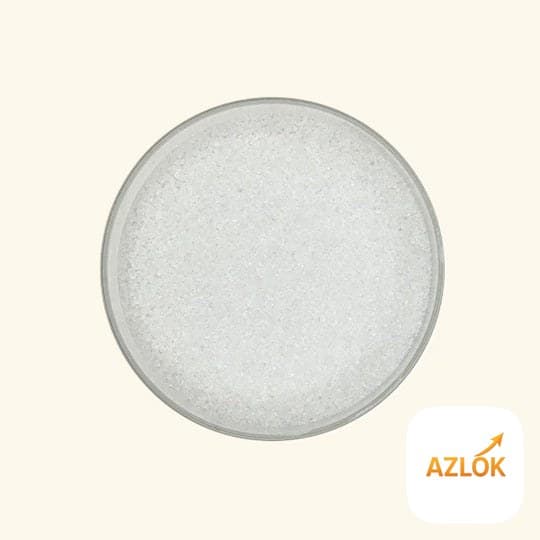

Polyvinyl Alcohol Cold Powder
Minimum Order: 1 units
Description
Polyvinyl Alcohol (PVA) Cold Powder is a water-soluble synthetic polymer that dissolves in cold water without heating, making it suitable for cosmetic formulations, peel-off masks, adhesives, and paper coatings. Azlok supplies food-grade and cosmetic-grade PVA powder in sizes from 100 g to 25 kg for formulators and small businesses.
History & Discovery
Polyvinyl alcohol was first synthesised in 1924 by German chemists W. Herrmann and W. Haehnel by hydrolysing polyvinyl acetate. Unlike most polymers, PVA is not produced by direct polymerisation of its monomer; vinyl alcohol exists primarily as its tautomer acetaldehyde in free form. Industrial production of PVA began in the mid-20th century and it quickly became important in textile sizing, paper coatings, and adhesives. The development of cold-soluble (or cold-dispersible) grades came later to meet demand from formulators who needed a polymer that could hydrate at room temperature without prolonged heating.
Scientific & Medicinal Importance
PVA is produced by partial or complete hydrolysis of polyvinyl acetate to remove the acetate groups. The degree of hydrolysis and molecular weight determine its solubility and film-forming properties. Cold-powder grades are specially processed (often partially hydrolysed, typically 87–89% hydrolysis) so that they swell and dissolve in cold or lukewarm water, unlike fully hydrolysed grades that require hot water. PVA forms clear, tough, flexible films with good oxygen-barrier properties. It is biodegradable under certain conditions and has low toxicity, which is why it finds use in cosmetics and pharmaceutical coatings. In aqueous solution, PVA acts as a thickener, binder, and film former.
Modern-Day Applications & Benefits
In cosmetics, PVA cold powder is the primary ingredient in DIY and commercial peel-off face masks. When dissolved in water and applied to the skin, it dries to a flexible film that can be peeled away, removing surface debris. It is also used as a binder in pressed powders, a thickener in gels, and a film former in hair-styling products. Beyond cosmetics, PVA is used in paper and textile sizing, wood glue formulations, and as a protective colloid in emulsion polymerisation. In craft and school use it is a key component of slime and papier-mâché pastes. Azlok's cold-powder grade is convenient for small-batch formulators who lack heating equipment, as it dissolves at room temperature with stirring.
Why Azlok's Version is Trusted Today
Azlok
Frequently asked questions
What concentration of PVA powder should I use for a peel-off mask?
A typical peel-off mask uses 10–15% PVA by weight in distilled water. Dissolve the powder in cold or room-temperature water with slow, steady stirring to avoid lumps, then add other actives once fully dissolved.
Is this PVA powder safe to use on skin?
PVA is widely considered low-toxicity and is used in cosmetic formulations globally. However, it is a raw chemical ingredient — always do a patch test on a small area of skin before full use, and keep it away from eyes. It is not intended for internal use.
How do I dissolve PVA cold powder without lumps?
Sprinkle the powder slowly into water while stirring continuously — never dump it all at once. Use a mechanical stirrer or whisk if possible. Cold-grade PVA typically hydrates fully within 30–60 minutes at room temperature.
Can I use this PVA powder for making slime or craft projects?
Yes. PVA cold powder dissolved in water (roughly 4–8% solution) is a suitable base for slime and papier-mâché. It is the same polymer used in white school glue formulations, though concentration and additives will vary.
What is the shelf life and how should I store PVA cold powder?
PVA cold powder is stable for 2 years or more when stored in a cool, dry place in a sealed container away from moisture and direct sunlight. Exposure to humidity can cause clumping and premature hydration.
Specifications
Documents
Safety data sheet not yet published for this product — request one below and we will email it.
How to use Polyvinyl Alcohol Cold Powder
Guides covering uses, dilution, safety and storage.