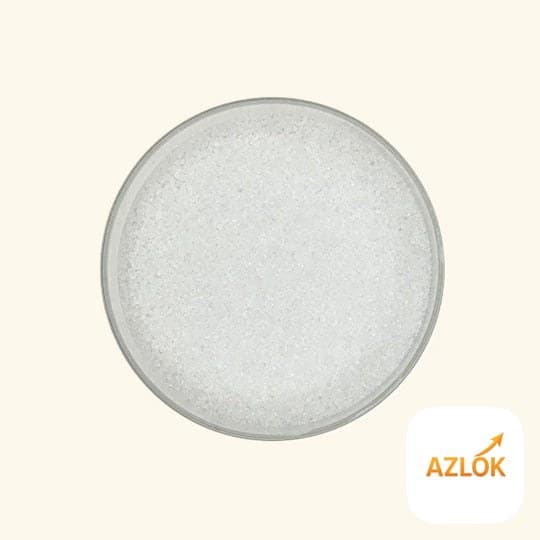

Polyvinyl alcohol cold powder is a water-soluble synthetic polymer that dissolves in cold or room-temperature water to form a clear, film-forming solution. It is widely used as a base for peel-off face masks, as a thickener and film former in DIY cosmetics, and in craft and industrial applications like adhesives and textile sizing. The "cold" grade simply means it disperses without needing hot water, which makes it convenient for home and small-batch use.
What is polyvinyl alcohol cold powder?
Often shortened to PVA or PVOH, polyvinyl alcohol is a white to off-white free-flowing powder. When mixed with water it swells and then dissolves into a viscous, slightly sticky liquid that dries down into a flexible, transparent film. The cold-soluble variety is designed to dissolve at lower temperatures, unlike hot-grade PVA that requires heating. Azlok Polyvinyl Alcohol Cold Powder is sourced for consistent purity, so it behaves predictably batch to batch.
Common uses
- Peel-off face masks: PVA is the classic ingredient behind DIY peel-off masks. It forms a thin film on the skin that lifts away when peeled.
- Film former in formulations: Small amounts add a smooth, peelable or protective film in gels and packs.
- Thickening and binding: It gives body to water-based mixtures and helps bind powders.
- Craft and DIY projects: Used as a base for homemade glues and slime, and as a general water-based binder.
- Industrial and textile use: Employed in textile sizing, paper coating and as a mould-release or protective coating agent.
How to dissolve it in cold water
The key with any PVA is to avoid clumping. A little patience gives you a smooth, lump-free solution.
- Measure your water into a clean container. A typical starting ratio for masks is around 8–12% powder to water, but adjust to the texture you want.
- Sprinkle the powder slowly onto the water surface while stirring continuously, rather than dumping it all at once.
- Keep stirring to disperse the particles and break up any lumps.
- Let the mixture rest for several hours, or overnight, so the polymer fully hydrates.
- Stir again before use. Gentle warming can speed hydration, but the cold grade does not require it.
A higher powder-to-water ratio gives a thicker, faster-drying film; a lower ratio gives a thinner, more spreadable solution.
Safety and handling tips
- Avoid inhaling the fine powder while measuring. Work in a ventilated area and consider a dust mask for large quantities.
- For skincare use, always patch-test a small area first and keep peel-off masks away from the eyes, eyebrows, hairline and any broken or irritated skin.
- This is a raw material. If you are formulating cosmetics for sale, follow good manufacturing practice and use an appropriate preservative in water-based products, as they can grow microbes.
- Keep away from children and pets. Do not ingest.
- Clean spills of the dry powder before adding water, as it becomes slippery once wet.
Buying and storage
Azlok offers Polyvinyl Alcohol Cold Powder starting at ₹299, in pack sizes from 100 g for small experiments up to 25 kg for bulk and commercial needs. Choose a smaller pack first if you are testing a formulation, then scale up once you settle on a recipe.
Store the powder in a cool, dry place in a tightly sealed container, away from moisture and direct sunlight. Because it is hygroscopic, it can clump if exposed to humid air, so reseal the pack promptly after each use. Prepared water-based solutions are best made fresh or preserved and refrigerated, and used within a short window.
FAQ
Does cold-water PVA need to be heated?
No. The cold grade is designed to dissolve in cold or room-temperature water. Heat can speed up hydration but is not necessary. Slow addition and adequate resting time matter more than temperature.
What ratio should I use for a peel-off mask?
A common starting point is roughly 8–12% powder to water by weight. Use more for a thicker, quicker-drying film and less for a thinner one. Test small batches to find what suits you.
Is polyvinyl alcohol safe for the skin?
It is widely used in cosmetic peel-off products as a film former. Still, sensitivities vary, so patch-test before wider use and keep it away from the eyes and broken skin. Do not ingest.
Why is my solution lumpy?
Lumps usually form when powder is added too quickly. Sprinkle it slowly onto stirring water, disperse thoroughly, then let it hydrate for several hours or overnight before stirring again.
How should I store it long-term?
Keep the dry powder sealed in a cool, dry place away from moisture and sunlight. Reseal promptly, since the powder absorbs humidity and can clump over time.