

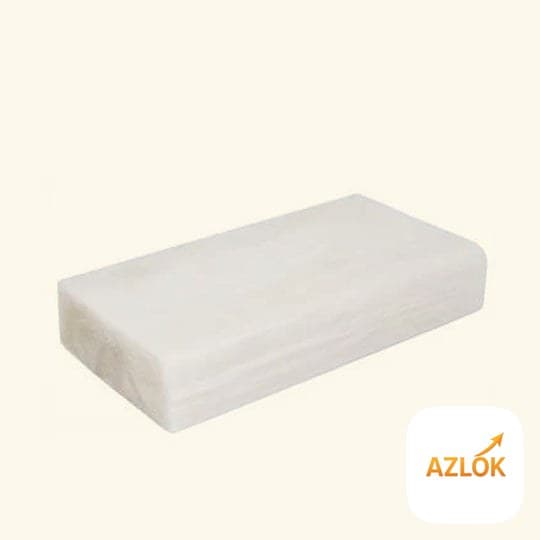

White Beeswax
Minimum Order: 1 units
Description
White Beeswax (CERA ALBA, CAS 8012-89-3) is a filtered, bleached natural beeswax available at Azlok in slabs from 500 g to 25 kg. With a melting point of ~63.8 °C and saponification value of 88.73, it is used in lip balms, lotions, soaps, candles, and cosmetics.
History & Discovery
Beeswax has been collected and used by humans for thousands of years. Ancient Egyptians used it in cosmetics, wood polish, and as a sealant in shipbuilding. In medieval Europe it was the primary material for church candles and wax seals. Yellow beeswax is the raw form secreted by honeybees (Apis mellifera and related species) to build honeycomb. White beeswax is produced by exposing yellow beeswax to sunlight, air, or controlled bleaching processes, which removes the carotenoid pigments and some of the propolis content while retaining its functional properties. India has a long tradition of beekeeping, and Indian beeswax is a commercially significant export commodity.
Scientific & Medicinal Importance
Beeswax is a complex mixture of esters of long-chain fatty acids and long-chain alcohols, along with hydrocarbons, free fatty acids, and minor amounts of propolis and pollen. Its primary ester component is myricyl palmitate. The saponification value of 88.73 indicates moderate ester content, which is relevant for soap-making calculations. Its melting point of approximately 63.8 °C makes it solid at room temperature yet easy to melt on a double boiler. White beeswax differs from yellow beeswax chemically in that bleaching reduces carotenoids and oxidises some unsaturated compounds; its INCI name CERA ALBA distinguishes it from yellow CERA FLAVA in cosmetic formulations. Beeswax forms a breathable, water-resistant film on skin, which helps retain moisture without fully occluding the skin surface.
Ayurvedic and Traditional Uses
In Sanskrit texts, beeswax is called madhuchchhishta, meaning 'what remains of honey', and is also referred to as siktha or sikthaka. It has been part of Ayurvedic practice for centuries, mainly as a base material. Classical preparations such as malahara (ointment-style preparations) and siktha taila combined melted wax with oils to give them a soft, spreadable body. Its role was functional: thickening oils and helping them hold their shape. Beyond Ayurveda, beeswax has a long history in Indian crafts. Dhokra metalwork uses the lost-wax casting method, which is still practised in parts of central and eastern India. These traditional references describe natural yellow beeswax. Today's white beeswax is filtered and bleached, so it has less colour and a milder smell. This makes it a common choice for formulators who want a neutral base. Patch test any skin product made with it, and use it externally only.
Modern-Day Applications & Benefits
White beeswax is a staple raw material in the cosmetics and personal care industry. It is used as a thickener and emulsion stabiliser in creams and lotions, a hardening agent in lip balms and lipsticks, and a binding wax in mascara and eyeshadow. In candle-making, beeswax candles burn longer and cleaner than paraffin candles with minimal soot. In soap-making, adding white beeswax increases bar hardness and longevity. Hair-care formulators use it in pomades and edge-control products. Azlok supplies white beeswax in bulk packs (up to 25 kg) suitable for small businesses, home crafters, and contract manufacturers. Store in a cool, dry place away from direct sunlight; shelf life is 2 years.
Why Azlok's Version is Trusted Today
Azlok
Frequently asked questions
What is the melting point of White Beeswax and how do I melt it safely?
White Beeswax melts at approximately 63.8 °C. Use a double boiler or a heat-safe container placed in hot water. Do not melt directly over an open flame as beeswax is flammable at very high temperatures. Keep a thermometer handy and do not overheat.
What is the saponification value and why does it matter for soap-making?
The saponification value of this white beeswax is 88.73. This figure tells you how much lye (NaOH or KOH) is needed to saponify one gram of the wax. Soap calculators use this value to adjust the lye amount when beeswax is included in a soap recipe, typically at 5–10% of the oil phase.
Is this white beeswax safe to use in lip balms and products that may contact lips?
White beeswax (CERA ALBA) is widely accepted as safe for use in lip care products including lip balms and lipsticks and is listed in international cosmetic ingredient databases. Azlok's white beeswax is a cosmetic-grade ingredient. If you have a known bee or honey allergy, perform a patch test or consult a professional before use, as beeswax may trigger reactions in sensitised individuals.
Can I use white beeswax for candle-making and how does it compare to paraffin?
Yes, white beeswax is suitable for candle-making. It burns at a slower rate than paraffin, produces minimal soot, and has a natural mild honey scent. Its higher melting point (~63.8 °C) means beeswax candles hold their shape better in warm climates. However, beeswax is denser and costs more than paraffin, so many makers blend it with other waxes.
What pack sizes are available and how should I store white beeswax?
Azlok offers white beeswax in 500 g, 1 kg, 5 kg, 10 kg, 20 kg, and 25 kg packs, starting at ₹339. Store in a cool, dry place away from direct sunlight and heat sources. Shelf life is 2 years when stored properly. Keep out of reach of children.
Specifications
How to use White Beeswax
Guides covering uses, dilution, safety and storage.