

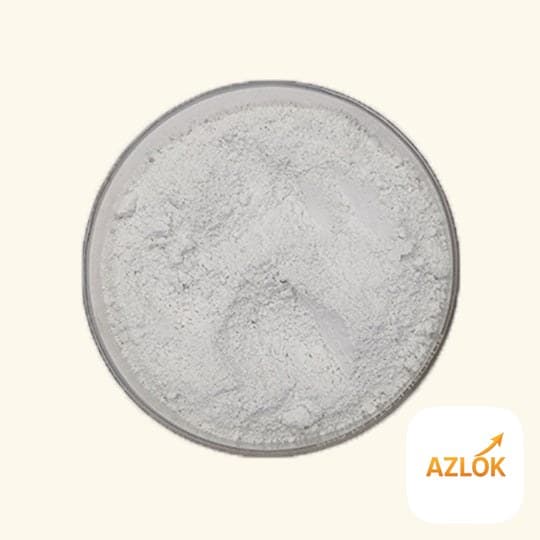

Kaolin Clay Powder
Minimum Order: 1 units
Description
Kaolin Clay Powder (China Clay) is a fine, white, pH-neutral mineral powder rich in kaolinite. Suitable for all skin types, it works as a gentle cleanser, exfoliator, and face mask base. Also used in hair care, toothpaste formulations, soap making, and cosmetic manufacturing. Available from Azlok in packs from 500 g to 25 kg.
History & Discovery
Kaolin, also called China clay, has been used for centuries — first in China, where it was mined to make fine porcelain and ceramics. The name 'kaolin' comes from Gaoling, a hill in Jiangxi province, China, where the mineral was first commercially extracted. By the 18th century, kaolin deposits were discovered across Europe and later in India, where large reserves exist in states like Rajasthan, Gujarat, and West Bengal. Its gentle, absorbent properties led to its gradual adoption in cosmetics, pharmaceuticals, and paper manufacturing alongside its traditional ceramic uses.
Scientific & Medicinal Importance
Kaolin is a soft, white phyllosilicate mineral with the chemical formula Al2Si2O5(OH)4. Its layered silicate structure gives it a fine particle size, low shrink-swell capacity, and near-neutral pH (6–7), making it exceptionally mild on skin compared to other clays such as bentonite or fuller's earth. The mineral has moderate oil-absorbing capacity, which is why it is preferred for sensitive and dry skin formulations. In cosmetics, kaolin acts as a bulking agent, opacifier, and gentle abrasive. Its high whiteness and chemical inertness also make it a valuable filler in paper, rubber, paint, and ceramics industries. Azlok's Kaolin Clay Powder is 98% pure, free from artificial colours, and has a shelf life of two years under dry storage conditions.
Ayurvedic and Traditional Uses
Clay pastes have a long place in Indian household and Ayurvedic practice. Classical texts refer to mrittika, or earth, as a material for external use, and clay-based lepas (pastes spread on the skin) have been part of traditional routines for centuries. In many homes, white clay, often called safed mitti, was mixed with water, rose water or milk and used as a simple face and body pack alongside multani mitti. Today, kaolin is a common base in herbal face packs. Its soft white colour and fine texture blend easily with powders like sandalwood, turmeric, neem leaf or rose petal. For any skin use, do a patch test first, use it externally only, and consult a doctor if you are pregnant or on medication.
Modern-Day Applications & Benefits
In modern cosmetic and personal care manufacturing, kaolin clay is one of the most widely used mineral ingredients. It features in face masks, foundation powders, dry shampoos, blushes, eyeshadows, and toothpaste as a mild abrasive and whitening agent. Its low sensitisation potential makes it suitable for formulations targeting sensitive, dry, or combination skin. In soap making, kaolin is added to bar soaps to give a silky lather and smooth skin feel. Small batch soap and cosmetic makers in India source kaolin in quantities ranging from 500 g for home use to bulk 25 kg bags for commercial production — all available through Azlok. Industrially, kaolin is also used in paper coating, ceramic glazes, rubber compounding, and as a filler in paints.
Why Azlok's Version is Trusted Today
Azlok
Frequently asked questions
Is Azlok Kaolin Clay Powder safe to use on sensitive skin?
Yes. Kaolin has a near-neutral pH (6–7) and very low irritation potential, making it one of the mildest clays available. It is widely used in formulations for sensitive and dry skin. Always do a patch test before applying any new cosmetic ingredient to your face.
Can kaolin clay be used in cold-process or melt-and-pour soap?
Yes. Add kaolin clay at 1–2 teaspoons per 450 g of oils. For cold-process soap, mix it into a small amount of oil before adding to the batter. In melt-and-pour, stir it in just before pouring. It gives a smooth, silky lather.
What is the difference between kaolin clay and bentonite clay?
Kaolin is a mild, low-swelling clay with neutral pH, best for sensitive or dry skin. Bentonite is a high-swelling, strongly absorbing clay with alkaline pH, more suited to oily skin and deep cleansing. Kaolin is gentler and less drying.
Is this kaolin clay food-grade or edible?
Azlok's Kaolin Clay Powder is listed for cosmetic, personal care, and industrial use — not for human consumption. Do not ingest. Keep out of reach of children. If accidentally swallowed in large quantity, seek medical advice immediately.
How should I store kaolin clay powder and what is its shelf life?
Store in a cool, dry place away from moisture and direct sunlight, in a tightly sealed container. Azlok's Kaolin Clay Powder has a shelf life of 2 years under proper storage conditions. Exposure to moisture can cause clumping but does not necessarily degrade the mineral itself.
Specifications
How to use Kaolin Clay Powder
Guides covering uses, dilution, safety and storage.