

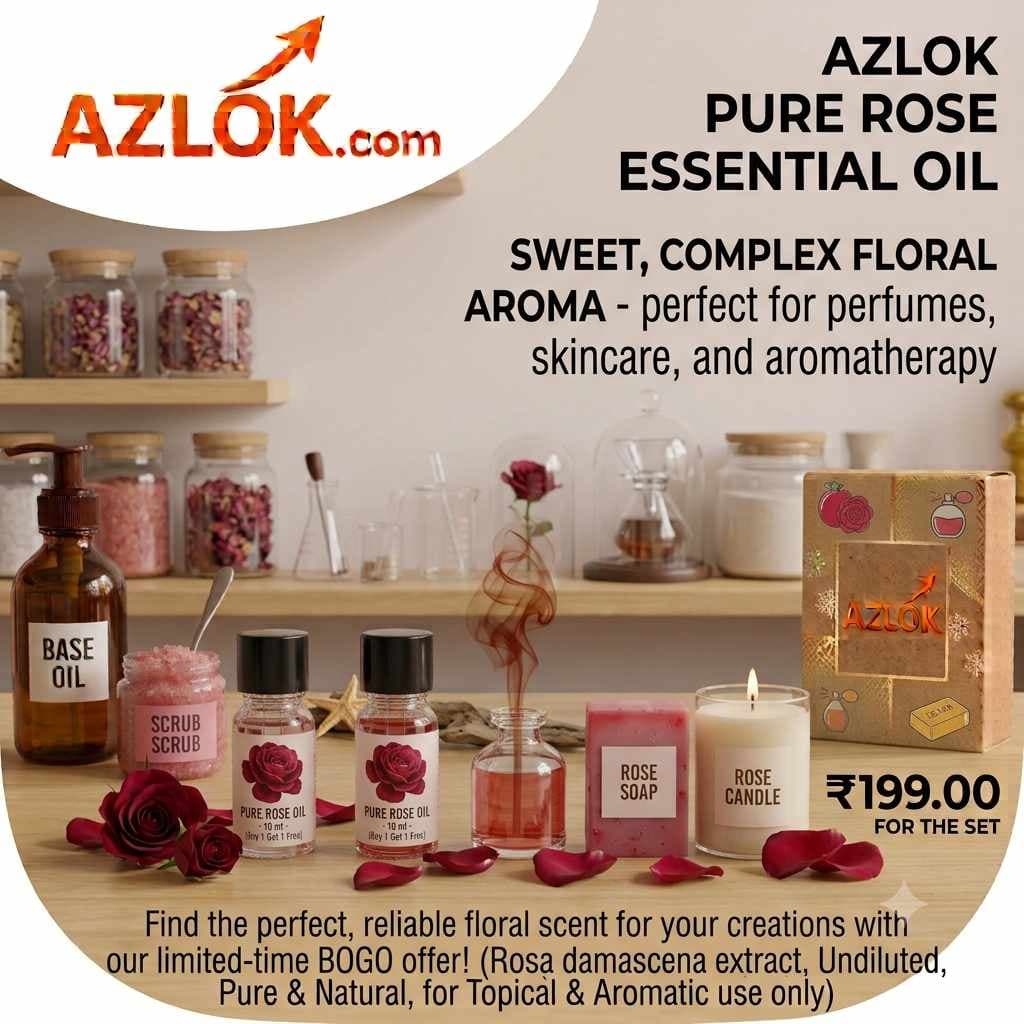
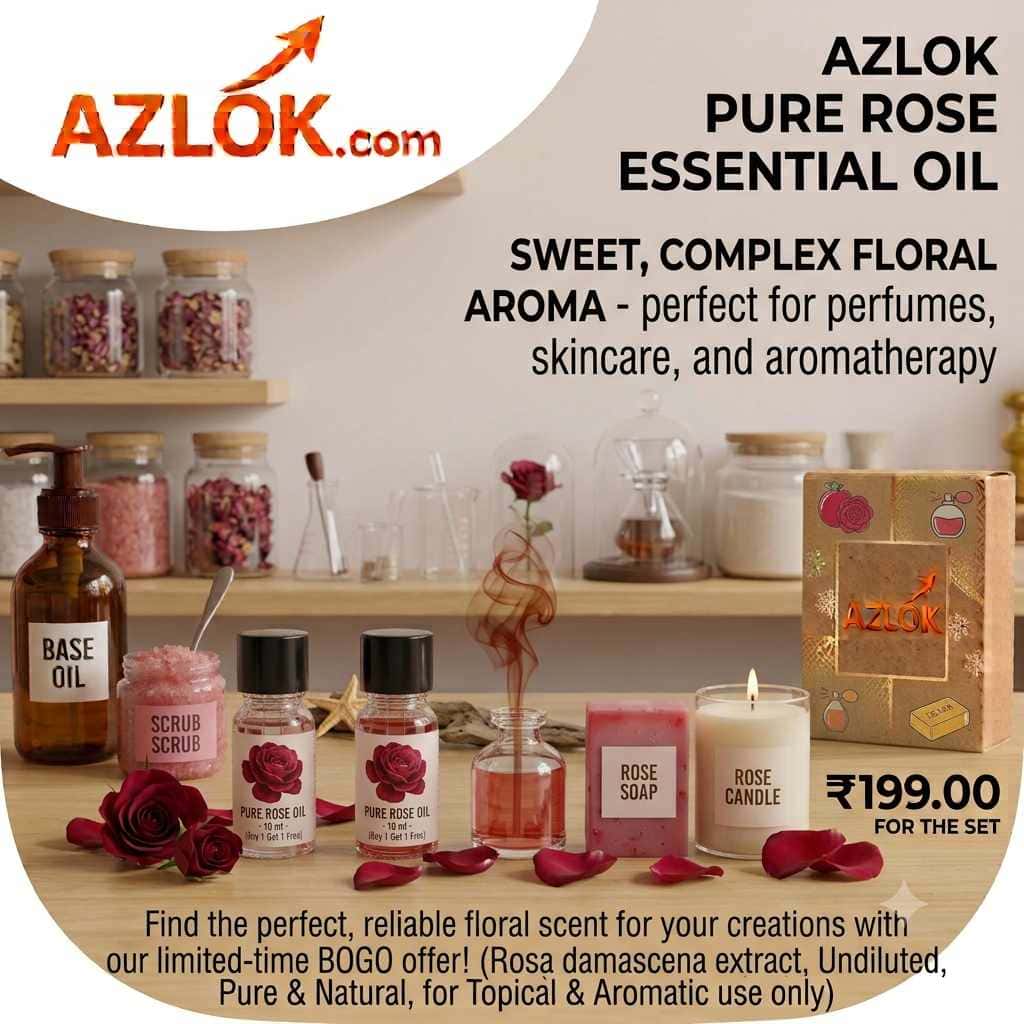
Rose Oil - 10 Ml | Buy 1 Get 1 Free
Minimum Order: 1 units
Description
Rose Essential Oil (Rosa damascena) from Azlok is a pale yellow, sweet floral oil extracted by solvent extraction from rose petals. CAS# 8007-01-0, flash point 190°C, soluble in alcohol. Used in perfumery, skincare, aromatherapy, and DIY soap and candle making. 10 ml, Buy 1 Get 1 Free.
History & Discovery
Rosa damascena, the Damask rose, has been cultivated for its fragrance for over a thousand years, with origins traced to the Middle East and Central Asia. Rose oil and rose water have been prized in Persian, Arab, and Indian traditions for use in perfumes, cosmetics, and ritual offerings. India, particularly Kannauj in Uttar Pradesh, has a long history of producing rose-based attars and hydrosols, making Indian-origin rose oil a respected product in global fragrance trade. Historically, rose otto (steam-distilled) was the most valued form, but solvent-extracted rose absolute became widely adopted in modern perfumery because it captures a fuller, truer representation of the flower's scent profile. The Azlok rose oil listed here is produced by solvent extraction, yielding what is technically a rose absolute or extract rather than a steam-distilled otto.
Scientific & Medicinal Importance
Rose absolute (CAS# 8007-01-0) is obtained by solvent extraction of rose petals, typically using hexane to produce a concrete, which is then washed with ethanol to yield the absolute. It has a specific gravity of approximately 0.918, a refractive index of 1.518, optical rotation of -4 to +2, and a high flash point of 190°C, making it relatively safe to handle compared to more volatile essential oils. The major aromatic constituents of Rosa damascena oil include citronellol, geraniol, nerol, rose oxide, and damascenone, which together produce its characteristic complex, sweet floral scent. Because it is solvent-extracted, trace solvent residues may be present; it is therefore not considered food-grade. The oil is soluble in alcohol and most fixed oils, and blends harmoniously with geranium, sandalwood, vetiver, and frankincense essential oils.
Ayurvedic and Traditional Uses
In Ayurveda, Rosa damascena (known as Shatapatri or Taruni) is considered cooling and balancing for Pitta dosha. Rose-based preparations such as gulkand (rose petal preserve) and rose water (ark gulab) have traditional uses for cooling the body, supporting digestion, and calming the mind. However, these Ayurvedic preparations use whole petals or hydrosols, not solvent-extracted rose absolute. Solvent-extracted rose oil as sold here is a cosmetic and aromatic ingredient and is not an Ayurvedic medicine or food supplement. Any references to Ayurvedic tradition apply to rose as a botanical, not to this specific extracted product.
Modern-Day Applications & Benefits
In modern perfumery, rose absolute is one of the most widely used floral ingredients — found in a significant proportion of fine fragrances worldwide. It blends well at the heart note level with geranium, sandalwood, vetiver, and frankincense. DIY perfumers typically use it at 1–5% in a fragrance blend diluted in a carrier such as jojoba or fractionated coconut oil. In skincare, diluted rose oil (0.5–1% in a carrier oil) is used in facial serums and creams for its fragrance and skin-conditioning properties. It is also popular in candle and soap making for its long-lasting scent. Always perform a patch test before applying to skin; dilute properly and never apply undiluted rose absolute directly to skin. Keep out of reach of children. Avoid contact with eyes. Not for ingestion — this is a solvent-extracted cosmetic ingredient, not a food-grade product.
Why Azlok's Version is Trusted Today
Azlok
Frequently asked questions
Is this rose oil pure and undiluted?
This is a rose absolute obtained by solvent extraction from Rosa damascena petals. It is not steam-distilled rose otto. It is sold as a concentrated aromatic ingredient and should always be diluted in a carrier oil before skin application.
Can I use this rose oil on my face?
Yes, but only after proper dilution. Mix 2–3 drops in 10 ml of a carrier oil (such as jojoba or sweet almond oil) before applying to the face. Do a patch test first. Never apply undiluted essential or fragrance oil directly to skin.
Is this rose oil suitable for candle and soap making?
Yes. Rose absolute blends well into wax and soap bases and provides a lasting floral scent. Use it at the recommended fragrance load for your specific wax or soap base (typically 6–10% for candles). Its high flash point of 190°C makes it suitable for most candle-making processes.
Can I ingest or consume this rose oil?
No. This is a solvent-extracted cosmetic ingredient, not a food-grade product. Do not consume it. Solvent extraction may leave trace residues that make it unsuitable for ingestion.
What is the shelf life and how should I store it?
The shelf life is 2 years from the date of manufacture when stored correctly. Keep the bottle tightly closed, away from direct sunlight and heat, in a cool dry place. Oxidation can degrade the scent and quality over time.
Specifications
How to use Rose Oil - 10 Ml | Buy 1 Get 1 Free
Guides covering uses, dilution, safety and storage.